Ocean Color System Gets a 'Refresh,' Allowing for More Precise and Accurate Measurements 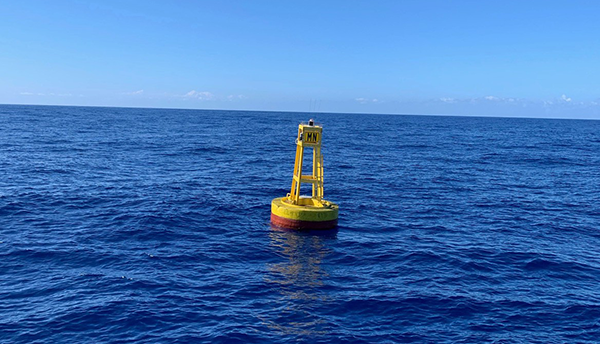 We typically think of the ocean's color as blue, but in some places, it looks blue-green. That's because those areas are teeming with single-cell plants called phytoplankton, which contain chlorophyll and reflect the green in sunlight. Though tiny, phytoplankton collectively absorb almost as much carbon dioxide as all the trees and land plants on Earth. They have an enormous impact on our climate, and scientists study that impact by measuring the color of the ocean with satellites and sea-based sensors. To ensure satellite measurements are accurate, researchers in the U.S. and many other nations rely on an ocean-color sensor called the Marine Optical Buoy (MOBY). Now, the National Oceanic and Atmospheric Administration (NOAA), Moss Landing Marine Laboratories (MLML), the University of Miami and the National Institute of Standards and Technology (NIST) have collaborated on an upgrade to the sensor, known as MOBY-Refresh, that will enable more precise and accurate measurements of sunlight's colors or wavelengths. | 









No comments:
Post a Comment